A French medical technology company

Laser precision,
engineered for surgical control.

LILASER is developing LaserTight™, a laser-assisted liposuction concept designed by and for plastic surgeons — built around controlled energy delivery, precise tissue-plane targeting, and a reproducible operative technique.

Precision · Control · Tightening Paris — Marseille — Dubai
Our vision

Beyond volume reduction: the soft-tissue envelope

Body-contouring surgery has traditionally focused on volume reduction. Yet the quality of the final contour depends not only on how much adipose tissue is removed, but also on how the overlying soft-tissue envelope redrapes after fat removal.

LILASER was founded on a clinical premise: laser energy should be delivered in a controlled and measurable manner, supported by structured training, and incorporated into a rigorous operative framework.

Our aim is not simply to introduce another device. It is to work with the surgical community to build a rigorous, documented, and reproducible approach to laser-assisted liposuction — also known as laser liposuction or laser lipolysis.

I.

Precision

Controlled energy delivery in the intended tissue plane, integrated into a precise operative technique.

II.

Control

Monitoring and measurement built into the design, providing objective intraoperative feedback.

III.

Tightening

Treating the soft-tissue envelope — and its potential for skin tightening — as an integral part of the body-contouring strategy, not an afterthought.
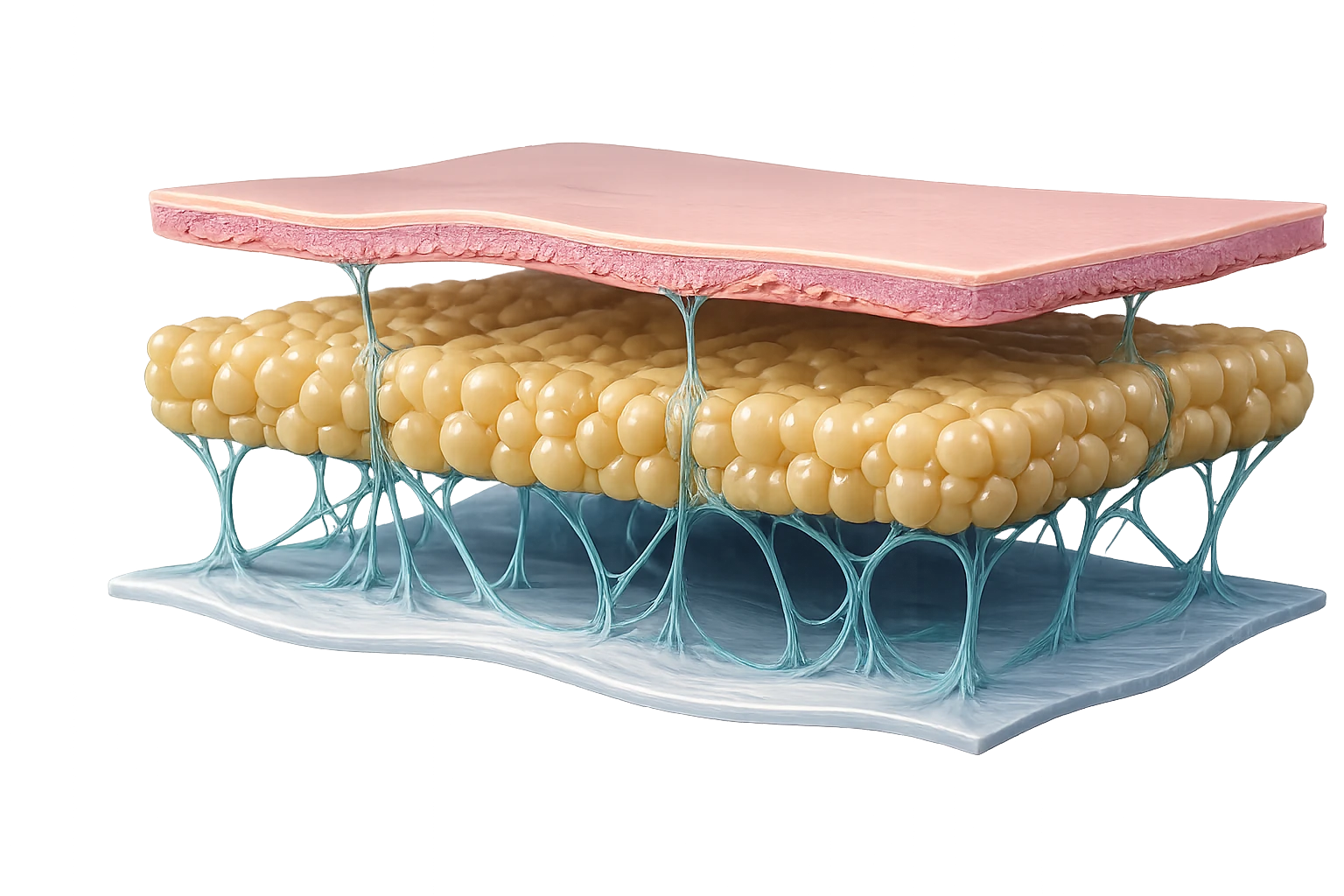

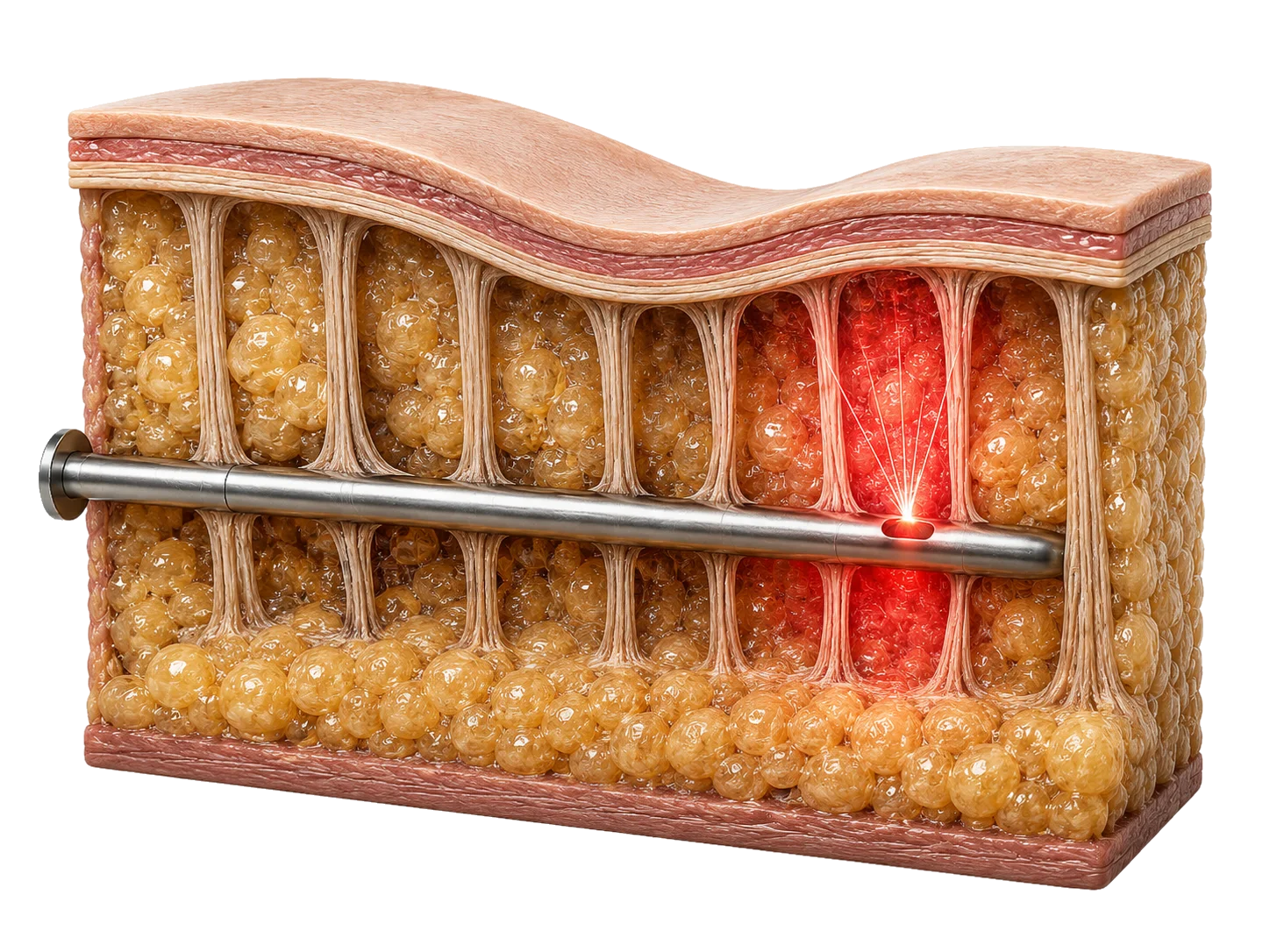
Conceptual cross-section of the dermis, subcutaneous adipose tissue, and fibroseptal network
The soft-tissue envelope comprises the dermis, subcutaneous adipose tissue, and the fibroseptal network linking the skin to the underlying fascial layers. Together, these structures influence soft-tissue redraping and the final contour. Conceptual illustration.
The concept

LaserTight™ — a laser-assisted liposuction concept

LaserTight™ is a laser-assisted liposuction concept combining two complementary wavelengths in sequence — one to facilitate fat disruption and removal, the other to deliver controlled subdermal heating — within an operative framework designed for temperature monitoring and reproducibility.

Anatomical cross-section showing the fibroseptal network between the dermis and the underlying fascial layers
The anatomical rationale: collagen-rich septa link the dermis to the underlying fascial layers. Controlled thermal energy is directed at this subdermal architecture — the intended thermal dose, in the intended tissue plane. Conceptual illustration; not evidence of clinical efficacy.

Two wavelengths, two complementary objectives

The objective is not to maximize power, but to sequence energy delivery deliberately: first to facilitate fat removal, then to deliver controlled thermal energy to the soft-tissue envelope.

Temperature monitoring

Temperature monitoring is built into the concept from the outset to provide intraoperative feedback on tissue heating.

A reproducible technique

A structured operative technique, designed to promote consistency across surgeons and reduce operator-dependent variability.

Safety by design

Defined operating parameters and procedural safeguards support the technique but never replace surgeon judgment.

Surgeon education and training

A technique is only as reproducible as the training behind it: structured initial training, mentorship, and competency assessment.

Prospective clinical data collection

We are committed to prospective data collection through a clinical outcomes registry so that each case can contribute to continuous evaluation and shared learning.

Treatment areas under evaluation: lower face and neck, upper arms, abdomen and flanks, and medial thighs
The concept is being developed for several treatment areas: the lower face and neck, including the submental region; the upper arms; the abdomen and flanks; and the medial thighs. Use in any anatomical area remains subject to appropriate indications, patient selection, training, and surgeon judgment. Conceptual illustration.

LaserTight™ is currently under development. This section describes the intended design and development framework only; it does not constitute a clinical claim, a guarantee of results, or an indication of commercial availability.

The right thermal dose,
in the right tissue plane.

Our standards

A clinically rigorous approach

Four principles guide LILASER's work, from research and development to the operating room.

01.

Science

Our scientific rationale is grounded in peer-reviewed literature, with a commitment to prospective research, publication, peer review, and claims proportionate to the evidence.

02.

Safety

Safety is treated as a core design requirement, with monitoring, operating parameters, and procedural safeguards built in from the outset.

03.

Training

A technology is only as effective as the surgeon using it — hence structured initial training, mentorship, and competency assessment.

04.

Data

Prospective, structured data collection is intended to turn cumulative clinical experience into a shared scientific resource.

The team

Surgeons, scientists,
and entrepreneurs

LILASER brings together a multidisciplinary team — spanning clinical practice, science, engineering, commercialization, and finance — united by a shared standard of rigor.

Julien Niddam
Julien Niddam
MD
Co-Founder & CEO
Plastic surgery · clinical strategy · operative protocols · surgeon training
Pascal Lemoine
Pascal Lemoine
MSc
Co-Founder & Commercial Director
20 years in medical technology · lasers, radiofrequency, ultrasound
Axel Maurice-Szamburski
MD, PhD, HDR
Chief Medical and Scientific Officer
Scientific oversight · clinical strategy · research and development
Pierre Nguyen
Pierre Nguyen
MD
Plastic Surgeon
Surgeon education · Europe
William Watfa
William Watfa
MD
Plastic Surgeon
Advanced liposuction · diode-laser surgery · Beirut and Dubai
Benjamin Mamou
Benjamin Mamou
MSc
Chief Financial Officer
Financial strategy · investor relations
Contact

Contact LILASER

We welcome conversations with surgeons, institutions, and scientific or industry partners who would like to learn more about our approach and explore potential collaboration.

Contact us